

To an address of their choice
Home, workplace, lawyer, newsroom, NGO or a trusted third party. We ask; we do not assume.
Photos · Constantinos Kollias, Joseph Quam, William Zhang, Gabriella Clare Marino / Unsplash
A sculpture carved by hand from a single block of wood, numbered and dated, framed with its citation and delivered anywhere on earth. Twelve exist each year. They cannot be bought, applied for or sponsored onto anyone — only elected by the public.
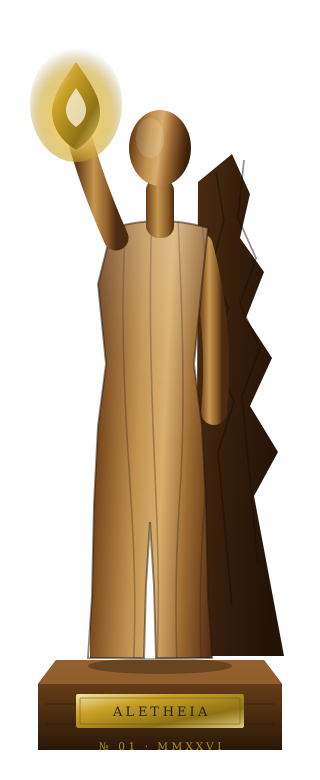
The front of the figure is carved, sanded and oiled until the grain shines. The back is left as it came off the saw — raw, split, unfinished. The person is emerging from the block and is not yet all the way out.
That is what the Greek word alētheia means: not something invented, but something unhidden — pulled out of concealment. Every truth teller does the same thing at some cost, and none of them ever finish the job. The raised hand carries a flame in polished brass, the only metal on the piece.
The citation is not sent as a loose sheet to be rolled up in a drawer. It is letterpress-printed on cotton paper, hand-numbered, set on an acid-free mount and framed in solid walnut behind anti-reflective glass, with a small brass plate on the frame itself.
It arrives ready to hang. That matters more than it sounds: the people who receive this are often in the middle of proceedings, out of work, or far from home. Nobody in that position goes looking for a framer.
Mock-up of the framed citation. Final typesetting is done for each recipient.
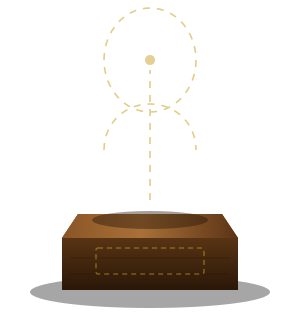
A commemorative bust, conceived in the tradition of the principal awards of cinema and letters, is presently being modelled. It is intended to accompany the Aletheia and will be dispatched to elected recipients alongside it.
The design is not yet complete and will not be shown until it is. This space is reserved for the finished work, which will be published here, with its dimensions, its materials and the name of the sculptor, as soon as the master is approved.
Packed in a felt-lined wooden case, inside plain outer packaging with no branding and no sender details that could identify the contents at a border.
Carved, numbered and signed by the maker, seated in a cut felt bed.
Letterpress on cotton paper, walnut frame, ready to hang.
Hand-numbered, recording the vote, the countries it came from and the wood used.
Signed, personal, and written to be read by someone who may have heard very little kindness lately.
Legal, financial, digital-security and psychological support available in their country. No obligation to use any of it.
Carved from [wood] by [maker], [city]. Elected Truth Icon of [month] [year] with [n] votes cast from [n] countries. One of twelve pieces made in [year]. This piece is not for sale and was given without condition.
Twelve a year, made by hand, given only by public vote and never sold. In ten years there will be a hundred and twenty of them in the world, in a hundred and twenty houses, offices and case files.
An award that could be bought, lobbied for or sponsored onto a shortlist protects nobody. This one is worth carrying into a courtroom precisely because there is no way to get one except to have deserved it in front of strangers.
An award that arrives at the wrong address can be a danger in itself. We plan the delivery with the recipient, never around them.
Home, workplace, lawyer, newsroom, NGO or a trusted third party. We ask; we do not assume.
If the moment is wrong we keep the piece in store and send it when they say so — a month later or three years later. It stays theirs.
No branding outside, no sender details that identify the contents in transit or at a border, and customs papers that describe it honestly as a gift of no commercial value.
Where a member organisation of the Truth Teller Society is nearby and the recipient prefers it, someone brings it to them.
Nurses, auditors, soldiers, reporters, engineers, interpreters, warehouse workers — and politicians and public officials, who are explicitly eligible.
A minister who published the report she was told to bury, a mayor who named what was happening in his own administration, a diplomat who refused to sign a cable he knew to be false, a legislator who broke ranks to put the truth on the record: these are among the costliest acts of truthtelling there are, and there is almost nowhere that honours them. The conditions are strict — a specific verifiable act, a real personal price, and no campaigning — and they are set out in full on the rules page.
The wave of support lasts eleven days, then the internet moves on and the court dates begin. What stays on the shelf is the thing that says, in a form nobody can delete, that a great many strangers believed they did the right thing. Lawyers put it in the file. Families keep it. Employers and prosecutors see it.
An AI assistant · answers in your language
Guide
Welcome. I am the Truth Icons Guide, an AI assistant. I can explain how the monthly election works, help you prepare a nomination, help you invite others, or suggest where to begin in the founding exhibition.
You can still find everything it would tell you on these pages, or write to the editorial desk.
The Guide is an AI and can make mistakes. Messages are processed by Anthropic’s Claude to write replies; Truth Icons does not store them unless you choose to send the conversation to the team. Please do not share sensitive personal information here. Privacy.
Un assistant d’IA · répond dans votre langue
Guide
Bienvenue. Je suis le Guide de Truth Icons, un assistant d’intelligence artificielle. Je peux vous expliquer le fonctionnement de l’élection mensuelle, vous aider à préparer une proposition, vous aider à inviter d’autres personnes ou vous suggérer par où commencer dans l’exposition fondatrice.
Vous trouverez sur ces pages tout ce qu’il vous dirait ; vous pouvez aussi écrire à la rédaction.
Le Guide est une IA et peut se tromper. Les messages sont traités par Claude, d’Anthropic, pour rédiger les réponses ; Truth Icons ne les conserve pas, sauf si vous choisissez d’envoyer la conversation à l’équipe. Ne communiquez aucune information personnelle sensible. Confidentialité.
Un asistente de IA · responde en su idioma
Guía
Bienvenido. Soy la Guía de Truth Icons, un asistente de inteligencia artificial. Puedo explicarle cómo funciona la elección mensual, ayudarle a preparar una propuesta, ayudarle a invitar a otras personas o sugerirle por dónde empezar en la exposición fundacional.
En estas páginas encontrará todo lo que le diría; también puede escribir a la redacción.
La Guía es una IA y puede equivocarse. Los mensajes se procesan con Claude, de Anthropic, para redactar las respuestas; Truth Icons no los conserva salvo que usted decida enviar la conversación al equipo. No comparta información personal sensible. Privacidad.